
At the end of the first day of play, it is the home side that is firmly in control, and India that is now reduced to chasing the game.

Prem Panicker previews the day-night Test at Adelaide.

Here's Prem Panicker's unique take on all the action from the fourth day of the 2024-2025 Border Gavaskar series.

Here's Prem Panicker's unique take on all the action from the third day of the 2024-2025 Border Gavaskar series.

Prem Panicker returns to his home ground -- Rediff.com -- for the Border Gavaskar Trophy series.

Here's Prem Panicker's unique take on all the action from the opening day of the 2024-2025 Border Gavaskar series.

Here's Prem Panicker's unique take on all the action from the second day of the 2024-2025 Border Gavaskar series.

'There will be a lot of spice to the contest -- there is a reason India is the only team other than England against whom Australia is keen to play a five Test series.' 'I'll watch, as I suspect most fans will -- but this one time, I'll watch with considerable trepidation and, from a fan's point of view, with the hope that the team finds its feet and that right quick,' notes the distinguished cricket commentator Prem Panicker.

Did Jeff Bezos decide against endorsing Harris because it would hurt his business interests? Only God and Bezos know, and neither of them are talking, notes Prem Panicker.

You don't prep for 2028 but for 2040, or even 2044. Sustained sporting excellence is based on mass support, grassroots development, and funding - and it is this trifecta India needs to work on, systematically, asserts Prem Panicker.

'The larger story of systematic destruction, which can and has been quantified, goes mysteriously missing from any political and/or public discourse about the ongoing devastation in the Ghats,' notes Prem Panicker.

For now, Modi's government appears singularly focussed on demonstrating that it is not in any way inhibited by the BJP's loss of a majority, and will continue along its patented path of bulldozing all opposition and doing just as it likes, asserts Prem Panicker.

For the first time in his political career, he failed to carry his party to even a working majority -- and again, for the first time in his career, he finds himself in a situation where he cannot rule by dictatorial fiat, points out Prem Panicker.

The best-case scenario is that the BJP will top out at around 50 seats in UP -- a drop of 12 from the 62 it had won in 2019. Taken in tandem with Maharashtra and Karnataka, this is what is likely to put paid to the BJP's ambitions of a third term for Modi, argues Prem Panicker.

In Phase 6, indications are that the BJP, which is defending 40 seats, will lose in double digits and gain in single digits. Not good, if you are the ruling party scrambling to earn a working majority, with just one phase left to go, argues Prem Panicker.

While people voted in a fifth round that will set the tone as this election rounds into the straight, and while Modi on the stump chews the cud of personal grievances and hackneyed promises that have long since passed their use-by date, there is a rogue wave rising -- what damage it will do, we will know 16 days from today, observes Prem Panicker.

'Are we so ready to believe that in this country whose virtues we constantly shout from the rooftops, there is no single person -- other than Modi -- in a minimum of 272 elected MPs with the talent and ability to lead this country?' asks Prem Panicker.

2019 was the Bharatiya Janata Party's breakout year, when it stretched the boundaries of what was thought possible and ended up with 303 seats on its own steam. Now it is forced to play defence, on a pitch queered by too many variables, asserts Prem Panicker.

On balance, RG contesting from Raebareli instead of Amethi isn't the masterstroke the party's adherents are touting it to be, but neither is it the blunder the BJP and its tame media is framing it as, points out Prem Panicker.
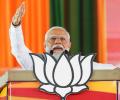
This time Modi has no emotive message to take to the stump. Muscular nationalism doesn't work against the backdrop of China's successive inroads into Indian territory. Rising prices is a sore point that cuts across class and caste barriers; unprecedented levels of unemployment has the youth in a ferment. This has reduced the BJP campaign to a laundry list of recycled grievances and thinly veiled communal appeals, neither of which are working as well as they have in the past, argues Prem Panicker.
